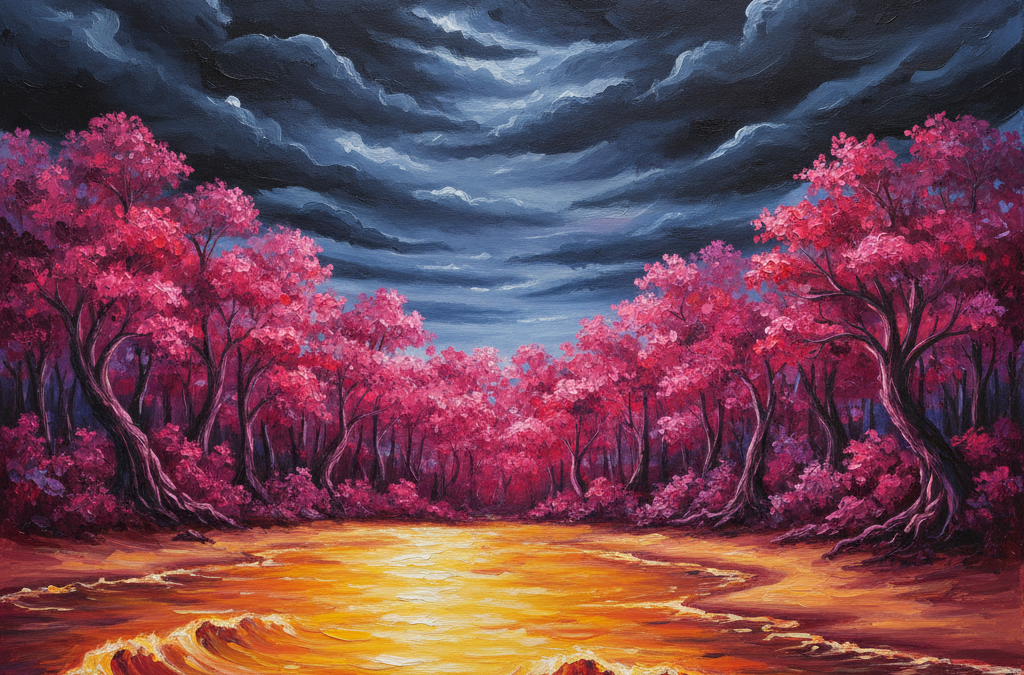
The Conventional Rule:
We’re taught that the color of an object is the light it reflects. When white light hits a surface, the object absorbs some wavelengths and bounces back the rest. A red apple, by this rule, is simply red because it throws the red light back at your eye.
What this rule doesn’t explain is whether the object is truly red; it only explains that the light reflected by it is “red”.
But what if this simple explanation is hiding a profound, inverse truth? What if the colors we see are not the essence of an object, but the leftover, rejected light. That tells us what the object is not, rather than what it is?
Imagine that apple again. Its material is chemically tuned to absorb green light—its true real color. It absorbs the green light and reflects/rejects the left over red light. Our eyes see the red, but the apple’s intrinsic color is green. As per the theory of reflection , what we see is not what it actually is. We just started calling apple “red” because we see it as “red” , not because apple is really red !!!
The world, in this light, is telling us its deepest secrets through subtraction.
Seeing What’s Left Over
Light is a spectrum of electromagnetic waves. When it strikes an object, the material’s atoms engage in a process of selection: some wavelengths are absorbed, and others are reflected. Our brain interprets the reflected wavelengths as color.
Nature gives us the clearest example of this inverse reality: leaves.
A leaf appears green because its active ingredient – chlorophyll – is desperately efficient at absorbing red and blue light to power photosynthesis. The green we perceive is not the color the leaf uses or “wants”; but it’s the unusable, rejected wavelength bouncing back at us. The leaf’s work—its purpose—is red and blue, yet its appearance is green to us.
In our inverse reflection scenario, this concept applies to everything: a pink dress is pink because its pigment is built to absorb its true complementary color yellow may be. And reflects back pink. The colors we see are merely the object’s rejected light.
The Universal Law of Rejection
This principle of inverse definition—where the essence is what’s retained, and the appearance is what’s rejected—is not unique to color. It is a universal law governing capacity and limit, a “Theory of Rejection” already in place throughout nature:
A glass of water is defined by its volume, while the spillover is the liquid it rejects past saturation.
A balloon is defined by its elasticity, but the burst is the air it violently rejects when pushed past its limit.
A pressure cooker is defined by its pressure threshold, and the audible whistle is the steam it actively rejects.
We reject food when our stomach is filled.
The world defines itself through what it keeps and presents itself through what it discards. Our perception of color is simply the most beautiful, pervasive example of this universal rule.
A Mirror of Reality
Our eyes construct color based only on the light that reaches them.
To truly understand this inversion, think of other ways reality communicates through absence or reversal:
• Shadows show us where light cannot reach.
• Mirrors show us a reflection of a surface, not the substance behind it.
• Echoes are the sound of what bounced back, not the original source.
Color is fundamentally similar—it is the reflection of light the object doesn’t absorb. The world around us may be is a mirror image of the reality beneath its surface.
The colors we perceive are not what things are. They are what things aren’t.
If this inverse model holds true, then:
• The greenery around you is not green— they are magenta
• The blue sea and sky are not blue—they are orange
• The white clouds, which reflect all light, are not white—they are ” “
You are right in the middle of a fake world of frabricated illusions. Every single thing you saw so far , you thought you knew and believed – is just an illusion.