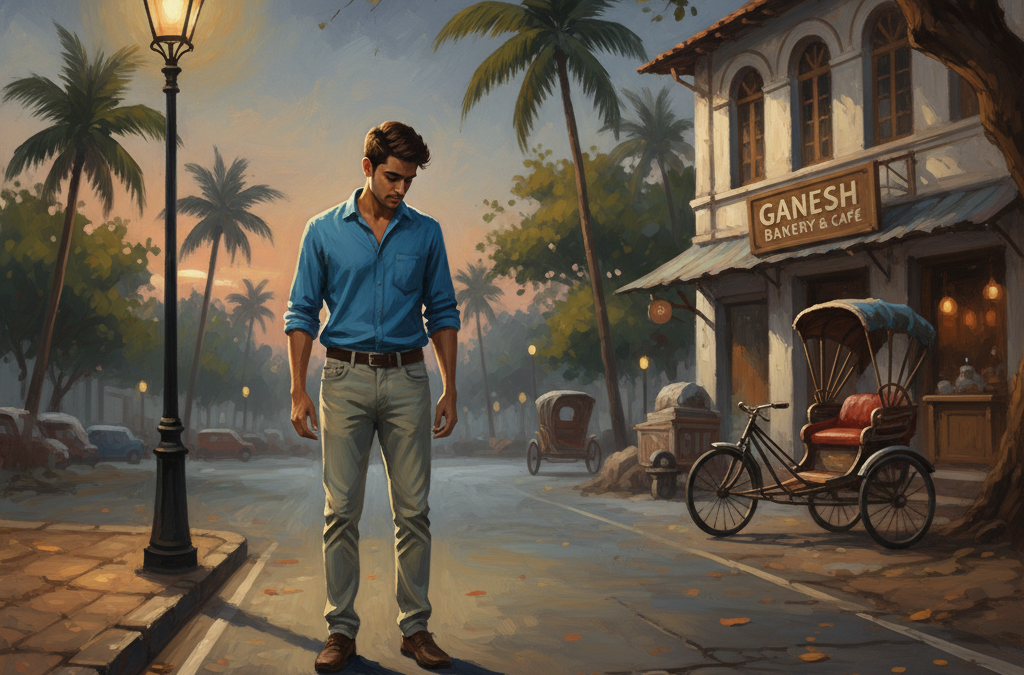
She wasn’t there… Four hours had passed waiting for her. The streetlights glowed at their fullest, casting long, wavering shadows. I found myself staring at them, tracing their shapes, as if searching for a sign.
The cafe owner made some noise to catch my attention. His glare carried a silent question. They were about to close for the day. I glanced at my watch once again and nodded toward him. Without thinking much, I decided to walk down the lane, leaving my car behind.
It had rained in the evening after a long time. The heat had been creeping in slowly, and the rain was a welcome relief. The roads shimmered under a wet sheen, carpeted with wings of rain flies.
It hasn’t been long — maybe three years — since I came to this town. This is my second hospital after completing my MD in Internal Medicine. It is a government hospital with very few staff — so few, and so indifferent, that patients rarely come in numbers. I arrive at the hospital at 11 a.m. or noon, depending on when I wake. No one cares. My consulting hours read 9 a.m. to 4 p.m., but I can’t remember a single day when I arrived at nine. Patients wait, indefinitely. Three or four each day. They smile, even when in pain. I never smile back.
I didn’t socialize with the other doctors, preferring the quiet space of my consulting room. Dr. Ranganathan, an older man specializing in cardiology, was perhaps the most dedicated. He held office hours religiously at nine, and worse, he actually cared. He was the kind of doctor who took time to explain a diagnosis and patiently counselled the patients’ families. Occasionally, we’d even share a silent cup of tea in the Duty Room, a gesture of camaraderie I barely tolerated. I found him inefficiently sentimental, but the nurses often referred to him as “a saint.” I rarely exchanged more than a few words with him, choosing indifference over engagement.
During the initial days , understanding the patients was a challenge. Most came from nearby villages. The hospital sat at the edge of the city, a place between two worlds. A nurse always stood in the consulting room to translate.
I haven’t spoken to my parents since I left home. Letters from Mom used to arrive every month. I used to read them , but stopped doing it at some point. I started leaving them unopened. I stopped counting them. The bundle rests on my table. I made sure she never knew my new address.
For the past five days I have been on and off the hospital. But kept waiting at the cafe for her — every day at our usual time. The cafe owner always knew our order: a cup of tea and two pieces of chocolate cake. Tea for me , cakes for her. It was never anything else.
I had no way to contact her. She didn’t have a phone or a mobile. She used to leave messages for me at Ismail Uncle’s shop. There weren’t any for a week. I could only hope she leaves one today. May be she went to her mom’s place for a some days.
It started raining again. The air had that deep, earthy scent, the one that comes only after long‑delayed showers. I must have reached the end of the lane by now — it was an aimless walk, guided by nothing but my own restlessness. The dim light from the streetlamps shimmered on wet stone, and the wings of rain flies swirled in restless patterns above puddles.
Few places offered shelter, but there was one — the small lean‑to that a security guard had claimed beside an unfinished villa. Its corrugated sheet roof was worn, rusted, and dripping water at the edges. I hurried toward it, my shoes splashing softly in the puddles.
Before I could speak, the guard looked up and said, “Come in, doctor. What are you doing here? Where is your car?” His voice was warm, familiar even.
It took me by surprise. He told me he had been my patient once, and thanked me for relieving his knee pain. I couldn’t recall clearly, but nodded as if I did.
He offered me a plastic chair while he settled on the floor. Around us, the rain pattered gently on the roof. He began speaking about the unfinished villa project he was guarding, about a land dispute for which clients had filed a case in court. His voice was steady, but I wasn’t listening. My nods and “hmm” were mechanical, misplaced. My mind was elsewhere — somewhere between the cafe and her.
He took a cup from his drawer, washed it in rainwater, and poured me black tea from his flask. I accepted it silently. It was my eighth cup of the evening. I had tried every option from the cafe — ginger tea, elaichi tea, masala tea, green tea — until the choices had run out. Every time I ordered, the waiter had given me a curious look. But I had to agree: the tea from the guard’s flask was the best that day. It had warmth beyond the flavor.
He sipped noisily from his own cup, speaking on in a low tone. The rain softened to a drizzle. Somewhere in the distance, thunder murmured faintly, like a restless memory.
I didn’t know how long I stayed there with him. The wet air wrapped around us – smell of soil and metal. Eventually, the rain settled. I thanked him for letting me in, for the tea, for the silence. There was no way forward — the road had ended. I stepped out, my shoes still damp, and walked back to my car.
I met her for the first time at the hospital. She was waiting with her mother at the auto stand near the main gate, drenched under a single umbrella. Rainwater trickled down her dress, and her mother kept calling someone who is not answering the call it seems.
The nurse entered, announcing we had no more patients for the day. I picked up my car keys and stepped outside. Raghav took them to park my car in the porch. I asked him if he knew them. He said they had been waiting for the past hour and were regular visitors to Dr. Ranganathan. I didn’t speak to other doctors or discuss cases. I didn’t even know many of their names.
At the gate, I lowered my side windows and asked her mother if I could help. Her mother did look tired and pale. She said there had been no auto due to a strike, and her son wasn’t answering his phone. I offered to drop them somewhere. She hesitated, then said softly, “If you could drop us at the junction, it would be great.”
They got in. Silence filled the car. Rain still trickled from the edges of her wet dress, forming small puddles on the seat. She fiddled with her sleeves, occasionally looking out the window. She was worried about the seats getting wet. Her eyes blinked thrice in quiet rhythm.
To break the silence, I asked her name. “Niveditha,” she said softly.
I asked her mother where they lived. She didn’t answer, her attention fixed on the phone in her hand. Finally, Niveditha said, “Behind Ismail Uncle’s shop.”
That brought a faint smile to my face. I wondered “Which Ismail Uncle? ” I looked at her in the rear‑view mirror and smiled. She didn’t return it — her gaze remained still, serious.
I wanted to know more about her mother‘s sickness , but she is still busy with her phone trying to call his son.
I dropped them at the junction as her mother had requested. The rain had slowed to a drizzle, and the air smelled of wet earth. She stepped down without looking back. Her mother thanked me. I drove away slowly, but the image of her waiting there stayed with me.
I met her again passing by the the market next day. She looked at me and blinked thrice. I smiled , she didn’t.
A few days later i met her again at the cafe. I smiled – this time she smiled back.
The days after that evening became a quiet rhythm. I found her waiting there again — at the same time, at the same table in the cafe. She was always there first. She talked. Always talked. Random childish topics under the sky and sometimes eveb above the sky. I mostly listened.
The city around us lived and moved. The cafe owner knew we would come. And so we met — without planning, without asking. Rain or shine – we found ourselves there. Her chatter became part of my days. My silence became a part of hers.
I kept coming to the cafe at our usual time. Waiting. Watching the street, the people passing, the light changing. Last few days – she wasn’t there.
I reached my car. The rain had stopped completely , but the wetness lingered — dense and alive. I didn’t feel like going home. The streets were empty, except for the quiet hum of the streetlights and the sound of rainwater slipping through the trees. Almost without thinking, I turned the car toward the hospital.
It was past midnight when I reached. The guard at the gate looked up and jumped from his chair to greet me. He wasn’t expecting me or any doctors at this time. It usually happens only if there is an emergency. I am not sure if he will be able to go back to his sleep now. He stood there perplexed. Inside, the corridors were pale and silent. The general ward was half-empty — a few patients asleep, the slow rhythm of a saline drip counting time. The duty nurses are half asleep.
I told myself I only wanted to keep my mind occupied — to stop replaying that empty cafe, that untouched pieces of cake, the chair across me that had stayed vacant for five long days.
At the end of the corridor, the record room door was slightly open. The register lay on the table, pages moving faintly under the fan. I stepped closer, for no reason I could explain.
My eyes caught the latest entry — the ink still fresh, the paper faintly damp at the edges
“PID : p272834”
“Name : Niveditha S”
“Age : 7”“Cause of death : Natural”
“Death Certificate issued by : Dr. Ranganathan”
My throat tightened. The letters blurred, but her name stayed sharp — painfully sharp. My hands trembled as I took out my phone and dialed Dr. Ranganathan
“Sir… Niveditha… ?” I somehow managed to speak those words
There was a pause. Then Dr. Ranganathan’s weary voice, soft and careful.
“She had a congenital cardiac defect. We tried surgical intervention, but it was not viable” he said quietly. “This was expected. I kept warning her mother , she was expecting a miracle to happen everytime she brought her to me“
I swallowed hard. “But sir… she was just seven…”
A silence. Then his voice, lower this time.
“I know dear. But sometimes, things are not under our control.”
I stood still. The fan hummed faintly above me
It started raining again.
The old tube light blinked.
Three times.